When business performance stalls, many leaders instinctively point to culture.
Something feels off.
Motivation seems lower.
The team doesn’t appear aligned.
So the response often becomes a culture initiative: resetting of values, a leadership workshop, or a team-building exercise. But culture is rarely the first domino to fall. More often, what appears to be a culture problem is actually something more practical — unclear priorities, capability gaps, or inconsistent leadership signals.
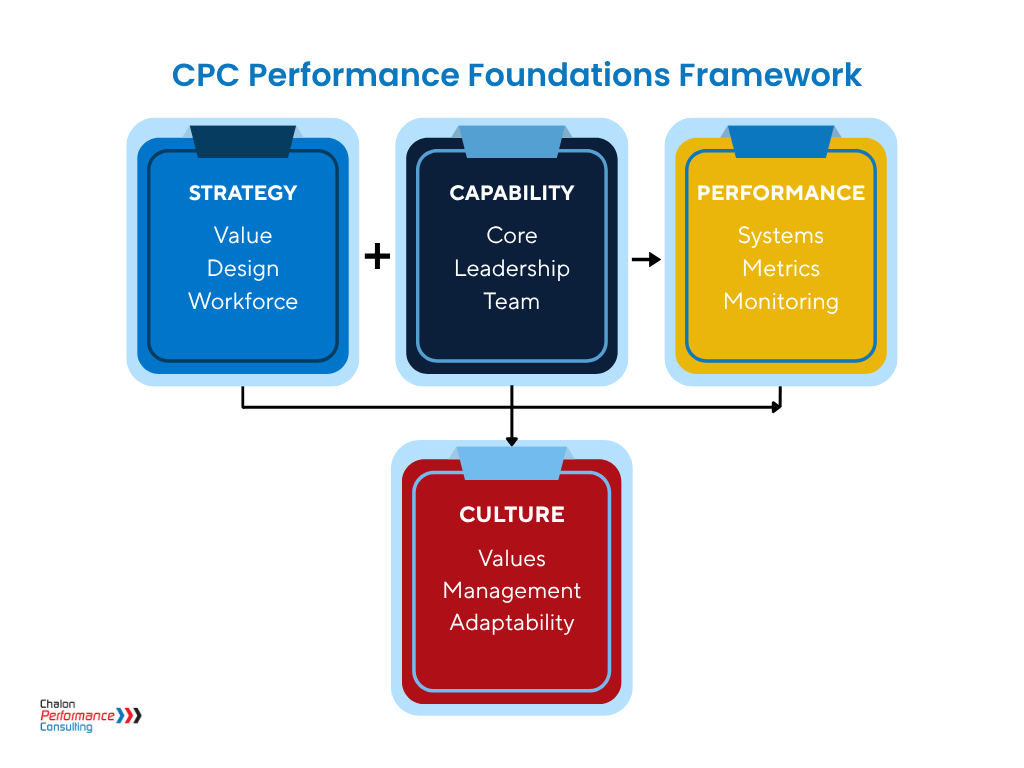
In reality, most organisational performance challenges can be traced back to three interconnected elements: Clarity, capability, and culture. When one of these breaks, performance begins to deteriorate. The challenge for leaders is identifying which one is actually responsible.
1. Clarity: Do People Know What Matters Most?
Clarity is one of the most powerful drivers of performance.
It determines whether people understand:
• the organisation’s priorities
• their role in achieving them
• how success is measured
Without clarity, teams become busy but ineffective. Work continues, but it doesn’t move the organisation forward. Research from Gallup shows that employees who strongly agree that they know what is expected of them at work are 2.5 times more likely to be engaged.
Engaged employees consistently outperform disengaged ones in productivity, profitability and retention. In SMEs, clarity problems often emerge as the business grows. Roles evolve organically. Responsibilities expand. Strategic priorities shift. But the structure around those roles doesn’t always keep up. Over time, people begin operating on assumptions rather than clear expectations. The result is misaligned effort. When clarity improves, performance often improves immediately.
Leaders can start by asking simple questions:
• What are our top three priorities right now?
• Does every role clearly support those priorities?
• Can each employee describe their most important outcomes?
If those answers vary widely across the organisation, clarity is likely the missing piece.
2. Capability: Do People Have the Skills to Deliver?
Even when priorities are clear, performance still depends on capability. Capability refers to whether employees have the skills, knowledge, and tools required to execute effectively. Many businesses assume capability exists simply because someone was hired for a role. But capability evolves. Markets change. Technology advances. Leadership responsibilities grow. Skills that worked two years ago may no longer be enough today.
According to McKinsey research, organisations that invest in structured capability-building programs see significantly stronger operational performance and adaptability.
This is particularly relevant for leadership roles. In many SMEs, strong individual contributors are promoted into management positions without formal leadership development.
Suddenly they’re responsible for guiding teams, managing performance conversations, and aligning people with strategy. Without training or coaching, many managers struggle with these responsibilities. The result is inconsistent leadership and unclear expectations for teams.
Investing in leadership capability often unlocks performance across the entire organisation.
3. Culture: How People Behave When No One Is Watching
Culture influences how people behave day to day. It shapes how decisions are made, how problems are addressed, and how accountability is handled.
Strong cultures reinforce behaviours that drive performance. Weak cultures allow poor habits to spread. Research from Deloitte shows that 94% of executives and 88% of employees believe a strong workplace culture is critical to business success.
However, culture is often misunderstood. It is not defined by posters on the wall or values written in company handbooks. Culture emerges from everyday behaviours, particularly those modelled by leaders. If leaders tolerate missed deadlines, unclear priorities, or blame-shifting, those behaviours become normalised. If leaders reinforce accountability, transparency and collaboration, those behaviours become the cultural standard.
In this sense, culture is often the result of leadership systems, not the starting point.
Why Leaders Misdiagnose Performance Problems
One of the biggest challenges in organisational performance is misdiagnosis. Leaders often implement solutions without identifying the underlying cause.
They run culture programs when the real issue is unclear strategy. They provide training when expectations were not defined. They restructure teams when leadership behaviours remain unchanged. Without diagnosing the real constraint, solutions rarely produce lasting results. Great leaders approach performance the way doctors approach health problems. They diagnose before prescribing.
A Simple Diagnostic for Leaders
If performance in your organisation is not where it should be, start by asking these questions.
Clarity
• Do employees clearly understand the organisation’s priorities?
• Are outcomes for each role clearly defined?
• Do people know how their work contributes to the bigger picture?
Capability
• Do teams have the skills needed to deliver on strategic priorities?
• Are managers equipped to lead, coach, and provide feedback?
• Are capability gaps identified and addressed?
Culture
• Do people take ownership of results?
• Is feedback encouraged and acted upon?
• Are problems addressed constructively rather than ignored?
Whichever category reveals the biggest gaps often identifies the real performance constraint.
Why This Matters for SMEs
Large organisations can sometimes absorb inefficiencies because of their scale. SMEs cannot.
When clarity disappears, productivity drops quickly. When capability gaps emerge, execution slows. When culture weakens, accountability fades. Understanding which element is missing allows leaders to focus their efforts where they will have the greatest impact, because performance rarely improves through guesswork.
It improves when leaders identify and strengthen the systems that support people.
If performance in your organisation feels inconsistent, ask yourself one question: Is the issue culture, capability, or clarity? The answer may not be obvious at first. But once leaders identify the missing piece, progress becomes far easier. Because sustainable performance is never accidental.
It is built deliberately through clear systems, capable people, and strong leadership behaviours.