Every SME has a big, obvious challenge they’re aware of — cashflow, staffing, sales consistency. But the real threat to growth is usually the one you don’t see. The one sitting quietly in the background. The one you only notice when something breaks.
For us at ChalonPC, that wake-up call came in October. A simple website disruption — not catastrophic, not long-term — but just enough to interrupt traffic, enquiries, and how people engaged with our content.
On the surface, it was a tech problem. But beneath it?
It exposed something far more important: internal processes that weren’t as tight, resilient, or aligned as we thought.
And that’s the story most SME leaders know too well.
Because it’s rarely the big strategy that derails performance… It’s the small, daily friction points no one is monitoring, fixing, or talking about.
1. The Hidden Cost of Internal Friction
SMEs often lose more time, money, and momentum through micro-failures than major crises.
A few real examples we see every week:
- Bottlenecks that depend on one “go-to” person
- Tasks that require manual double handling
- Delays caused by unclear ownership
- Data stored in multiple places with no single source of truth
- Processes that once worked at 5 people, but collapse at 15
Individually, they look harmless.
Collectively? They become the silent killer of performance.
According to McKinsey, employees lose up to 30% of their week to inefficient processes — rework, searching for information, duplication, waiting for approvals, or clarifying tasks. For SMEs with demanding delivery schedules, and tighter margins, that’s not inefficiency…That’s lost revenue, lost speed, and lost opportunity.
2. During the Disruption: The Lesson We Didn’t Expect
When our website experienced downtime, the immediate challenge wasn’t the downtime itself — it was everything the downtime affected.
Traffic dipped.
Enquiries slowed.
Our content calendar needed to shift.
Systems that were seemingly “set and forget” suddenly weren’t behaving as expected.
But the bigger lesson hit harder:
One disruption exposed five different internal processes that needed upgrading.
And this is the reality for most SMEs:
A small operational issue often reveals a much bigger systemic weakness. It’s the equivalent of a fuse blowing and realising half your electrical wiring needs to be redone.
3. Growth Isn’t Blocked by Strategy — It’s Blocked by Systems
Most SME owners think the main way to grow is:
- More clients
- More marketing
- Bigger team
- Improved service
- Automation
Those matter — but they can’t operate without one critical foundation:
Process Performance.
This is the layer where most SMEs fall down.
Your operations should evolve as the business grows — but SMEs often “carry the same processes forward” long after they have outgrown them.
When processes don’t keep up, three things happen:
- People work harder, not smarter.
Effort increases, output doesn’t. - Small mistakes snowball.
A missed deadline becomes a lost client.
A manual task becomes an error.
A delayed approval becomes a missed opportunity. - Leaders get stuck in the weeds.
Instead of focusing on planning, performance, and growth — they’re plugging holes.
Operational friction is the enemy of scalability. And it kills momentum quietly, slowly, and predictably.
4. Why Process Audits Should Be a Quarterly Habit
A process audit isn’t an IT exercise or a documentation exercise. It’s a performance optimisation exercise.
Every quarter (or after any disruption), SMEs should review:
- Where delays occur
- Where information gets stuck
- Which tasks rely on one person
- Where customer experience breaks down
- Where manual work is still happening
- Where technology isn’t supporting performance
This isn’t about overhauling everything. It’s about carefully diagnosing friction points and causes before it compounds.
When done consistently, SMEs see predictable benefits:
- Faster delivery times
- Reduced mistakes
- Empowered teams
- Better customer experience
- Clearer accountability
- A stronger foundation for growth
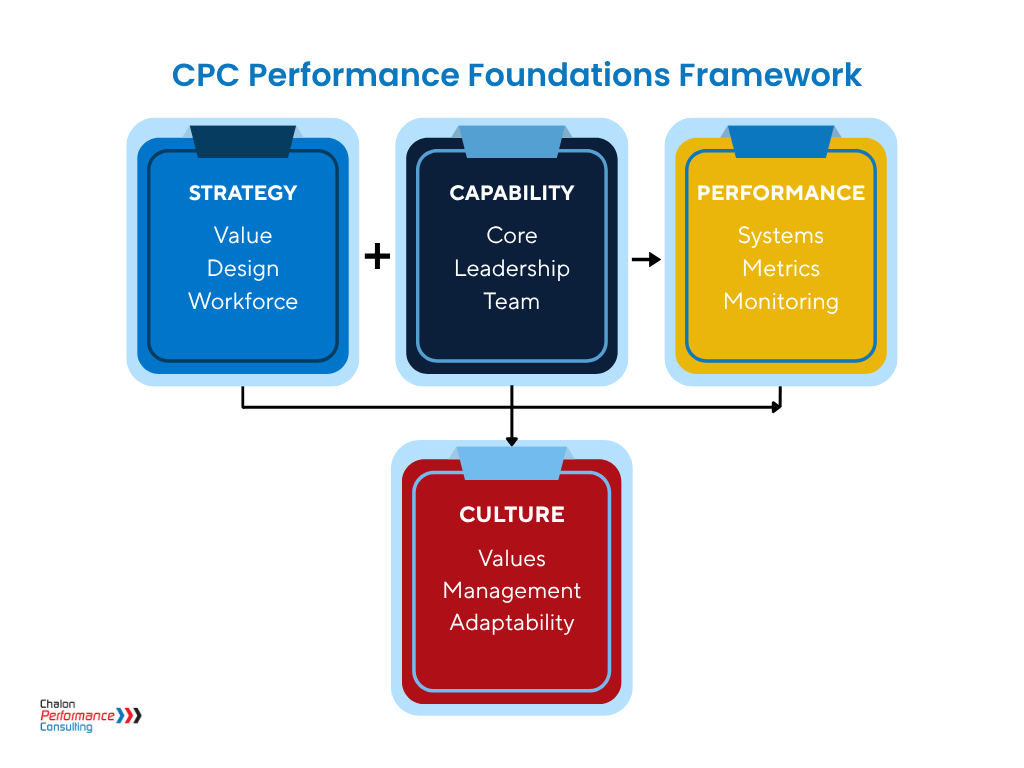
5. Using the CPC-PFF Framework: The Smart Way to Strengthen Performance
Internal processes don’t exist in isolation. They sit inside a bigger ecosystem — and that ecosystem must be aligned.
That’s why we use the CPC-PFF framework:
Strategy → Capability → (Processes → Operational Rhythm) → Culture → which in turn provides a template for Future Growth.
When these elements are fully optimised and align, performance improves exponentially.
The disruption forced us to walk our own model:
- Culture: Are we encouraging accountability over blame? Is our psychological safety intact?
- People: Does everyone understand their roles and areas of responsibility?
- Capability: Do we have the right tools, knowledge and skills to prevent recurrence?
- Processes: Where are the gaps? What are the causes? What needs updating?
- Operational Rhythm: How does downtime affect revenue flow and planning?
- Future Roadmap: How do we build monitoring and resilience into our systems moving forward?
This is the exact work SMEs must prioritise going into 2026.
6. The Real Takeaway: Downtime Isn’t a Setback — It’s a useful Diagnostic Tool
Most leaders see disruptions as annoyances. But the SMEs who grow fastest see disruptions differently. They treat them as data points, feedback loops, and alignment signals. Every operational issue says something:
- A breakdown reveals a weak link
- A delay reveals a process blind spot
- A recurring issue reveals a capability gap
- A disruption reveals a lack of resilience
And once you see these patterns, you can’t unsee them. The disruption reminded us — and reminded our clients — that you can have the right strategy, the right market, and the right team…
…but if your internal processes aren’t optimised, productivity stalls.
Operational performance isn’t exciting.
It doesn’t get applause.
But it’s the quiet, consistent engine behind every scalable business.
At ChalonPC, this is the work we do every day:
Helping SMEs eliminate friction, strengthen performance, and build systems that support long-term growth.
If 2026 is the year you want to scale, start by strengthening the part of your business no one sees —
your processes.