Most SMEs don’t struggle due to a lack of ambition or ideas.
They struggle because strategy breaks down once daily operations take over.
Planning sessions occur. Priorities are agreed. KRA’s, Objectives and Actions are documented.
Then pressure from customer issues escalates, teams react, leaders firefight — and strategy drifts from deliberation and decision-making into felt-fair reactions.
This pattern is not just anecdotal, it is structural. The default approach of “It’s the way we do things around here” takes hold and is hard to get around when faced with real-time pressure. The other poor outcome is that these decisions completely ignore any alignment with any Strategy..
McKinsey research shows organisations that regularly review and refresh strategic priorities are up to 60% more likely to execute successfully than those relying on annual planning alone.
Strategy Without Structure Loses Force
Execution weakens when strategy lacks:
- defined priorities
- decision-making boundaries
- a consistent review rhythm
Without these, even well-formed strategies lose traction.
Harvard Business Review refers to this erosion as organisational drag — complexity, competing priorities and slow decisions that quietly reduce productivity over time.
In SMEs, organisational drag rarely looks like bureaucracy.
It shows up as:
- constant urgency
- leaders involved in too many decisions
- teams unclear on what takes precedence
When Direction Fragments
Strategy dilution often occurs when:
- initiatives are added without removing others
- short-term issues override longer-term priorities
- operational noise dictates focus
Frantic Activity increases. Progress is sluggish.
McKinsey identifies weak strategic alignment as a frequent cause of execution failure, particularly when priorities are not reinforced through regular review cycles.
Strategy rarely collapses outright.
More often, it erodes.
Cadence Sustains Execution
Annual planning sets direction.
Execution depends on what happens between planning cycles.
High-performing SMEs maintain momentum by:
- revisiting priorities monthly or quarterly
- linking objectives to operational reality
- Monitoring progress visibly to gain real-time insight
- adjusting with corrective action, early
McKinsey’s performance research shows organisations with disciplined review systems are 4.2 times more likely to outperform competitors, achieving up to 30% higher revenue growth.
Execution improves when progress is examined regularly.
Capability Determines Feasibility
Strategy defines intent.
Capability determines what can be delivered.
McKinsey Global Institute research shows SMEs frequently underinvest in operational capability, contributing to lower productivity and stalled progress.
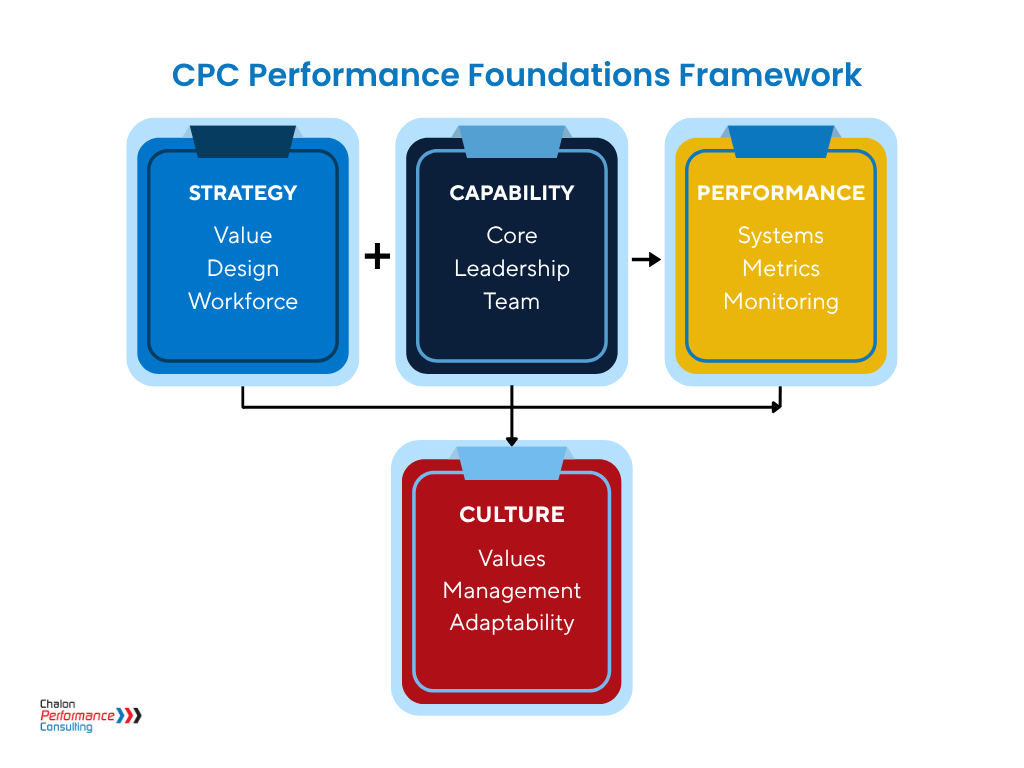
This is why ChalonPC places capability between strategy and people — ensuring systems, skills and processes support execution as priorities evolve.
Without this alignment, execution friction accumulates.
Strengthening Execution in 2026
Before the year ahead, SME leaders should consider:
- Which strategic priorities are non-negotiable?
- What work must stop to protect them?
- Do current capability and systems align and support delivery?
- How often is progress reviewed with intent?
Execution strengthens when leadership reinforces focus and follows through consistently.
A Practical Reset
Alignment drives execution.
When direction is clear, capability is deliberate, roles are understood and performance is reviewed honestly, progress becomes more predictable.
Recent conditions have reinforced a familiar pattern: strategies tend to stall when reinforcement fades.
ChalonPC supports SME leaders in strengthening execution by aligning strategy, capability, and performance — particularly when momentum has slowed despite clear intent.Explore our Strategy Development and Performance Management services to support disciplined follow-through heading into 2026.