Most Australian SME leaders would struggle to put a dollar value on workplace culture.
They can tell you their revenue. They know their margins. They track sales, cash flow, customer complaints and perhaps employee turnover.
But ask what their culture is costing them, or contributing to performance, and the answer is often less clear.
That is a problem.
Because culture is already affecting those numbers. And ignoring this vital asset is unhelpful.
Culture influences how people make decisions, whether managers address problems early, whether employees stay, how consistently work gets done and what customers experience.
The question for SME leaders is no longer whether culture matters.
It is whether they are treating it as a business asset.
The evidence is becoming difficult to ignore
There is a tendency to put workplace culture in the “people” category and financial performance in the “business” category. The evidence increasingly makes that separation difficult to defend.
Research from HR Coach/Fusion Culture, based on 234 Australasian businesses, found a 17% gap in management culture results between low- and high-performing businesses. The research also found that high-performing businesses reported substantially stronger strategic alignment.
That does not mean improving culture by 17% automatically produces a 17% increase in profit. That would be an overstatement.
What it does show is a meaningful relationship between management culture and business performance.
The broader engagement picture is equally uncomfortable.
For an SME leader, that is not simply an HR statistic.
It represents a large pool of capability that may not be translating into discretionary effort, problem-solving, customer focus or sustained execution.
Culture, therefore, deserves to be discussed alongside performance; not separately from it.
The mistake is treating culture as a feeling
Culture is often discussed in vague terms.
“Are our people happy?”
“Do we treat people well?”
“Is everyone engaged?”
These questions have their place, but they do not tell a senior leader enough.
A commercially useful view of culture asks different questions:
- Do managers deal with poor performance quickly?
- Do employees understand what matters most?
- Can people challenge decisions without creating unnecessary conflict?
- Are leaders consistent in what they say and do?
- Do teams take ownership when something goes wrong?
- Are good behaviours reinforced?
- Do people understand how their work affects customers and business results?
- Are decisions usually made at the level where the best information is available?
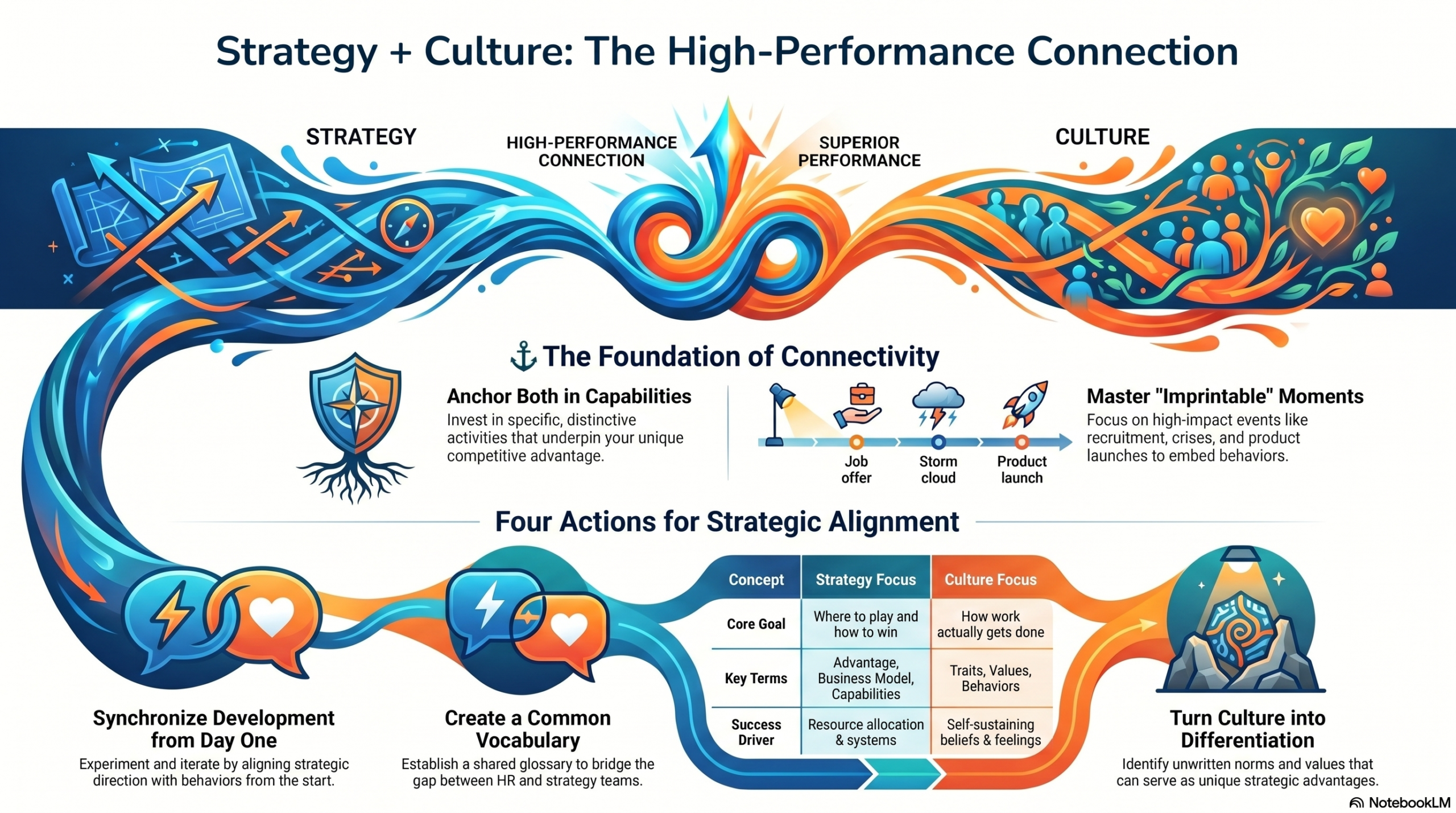
- Are the capabilities of people viewed as an important source of competitive advantage?
- Is there clear agreement about the right way and the wrong way to do things?
These are observable behaviours and practices.
And observable behaviours and practices can be measured. And we know that what is measured can be standardised and improved. This takes active management.
That is where culture becomes a performance issue rather than a philosophical discussion.
Australian employees are giving leaders another warning
Retention provides another way to look at the issue.
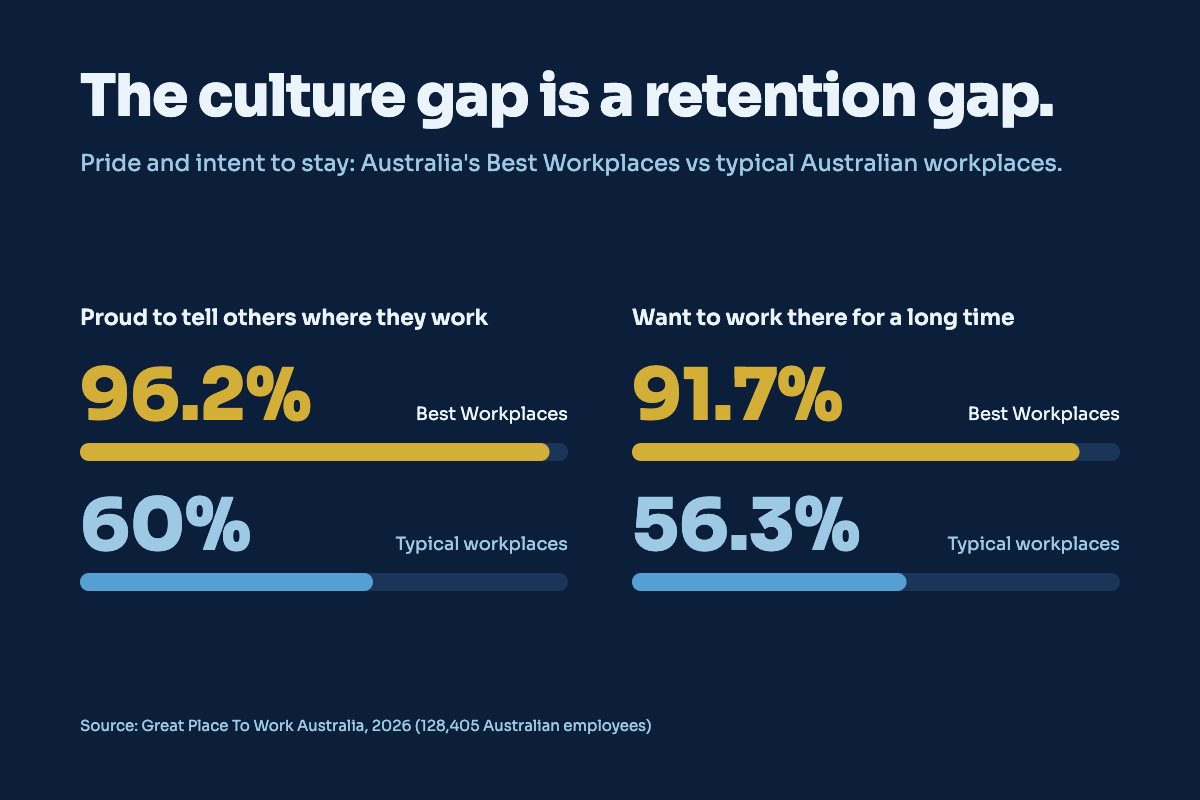
Great Place To Work Australia’s 2026 research analysed responses from 128,405 Australian employees. Its research found that pride was the strongest predictor of employees intending to stay, accounting for 25.8% of the retention relationship among the five culture themes measured.
The differences are substantial.
At Australia’s Best Workplaces, 96.2% of employees said they were proud to tell others where they worked. At typical Australian workplaces, the figure was 60%.
Among Best Workplaces, 91.7% said they wanted to work there for a long time, compared with 56.3% at typical workplaces.
Again, this does not mean culture is the only factor determining retention.
It does mean leaders should be wary of reducing retention to salary, recruitment difficulty or employee perks.
People experience the organisation through its culture every day.
Culture becomes particularly important when capability is scarce
Australian employers are also dealing with capability pressures.
The Australian HR Institute reported that employers expected to increase investment in learning and development, while its 2025 research found that employers perceived an average 16% of employees as not fully proficient in their roles.
That creates an important distinction for SMEs.
You can hire capable people. You can train them. You can apply better technology.
But if the surrounding culture discourages accountability, slows decisions, tolerates poor standards or makes people reluctant to speak up, capability will not automatically translate into performance.
This is why culture and capability should not be treated as competing priorities.
Capability determines what people can do.
Culture influences what gets done consistently.
What Australian SME leaders should measure
The answer is not another annual employee survey with 40 questions that produces a glossy report with a colourful dashboard that doesn’t impact performance. Let’s be clear – Engagement is derived from having a positive culture not the other way around.
1. Measure retention
Look at voluntary turnover by team, manager, tenure and role.
Then ask why people are leaving.
Do not stop at the headline percentage.
2. Measure leadership behaviour
Ask employees whether leaders:
- set clear expectations
- follow through on commitments
- address problems
- provide useful feedback
- make decisions consistently
Leadership behaviour is one of the most practical windows into culture.
3. Measure engagement
Gallup’s Australian numbers suggest there is considerable room for improvement.
But an engagement score on its own is not enough.
Find out what is driving it.
Is the problem workload? Leadership? Recognition? Clarity? Capability? Trust?
4. Measure performance alongside culture
This is where many organisations stop too early.
Compare cultural indicators with operational outcomes.
For example:
- employee turnover and customer retention
- engagement and productivity
- leadership scores and absenteeism
- capability gaps and error rates
- team culture and delivery performance
The objective is to discover relationships that matter to the business.
5. Look for cultural drift
Culture rarely collapses overnight.
It drifts.
A manager tolerates one missed deadline.
A difficult employee is left unchallenged.
A strategic priority becomes optional.
A customer complaint is explained away.
Eventually those exceptions become normal behaviour.
The most effective leaders catch that drift early.
Culture is not the responsibility of HR alone
This may be the most important point.
HR can measure culture.
HR can support leaders.
HR can design systems that reinforce desired behaviours.
But the CEO/MD and leadership team ultimately create the conditions in which culture develops.
Employees watch how leaders behave.
Employees watch what leaders reward.
They watch what leaders ignore.
They watch who gets promoted.
They watch what happens when performance falls short.
They watch who gets preferential treatment.
They watch what is tolerated and what is not.
Those decisions communicate more about culture than any values statement.
That is why culture should sit on the leadership agenda alongside strategy, capability and performance.
The real question for SME leaders
The strongest cultures are not necessarily the organisations with the best slogans, the most elaborate engagement programs or the most attractive offices.
They are organisations where the behaviours required for performance have become normal.
People know what matters.
Leaders act consistently.
Problems surface early.
Accountability is accepted.
Psychological safety is evident.
Capability is developed.
Customers experience the benefit.
And performance becomes less dependent on individual heroics.
That is why workplace culture should be treated as a business asset.
You do not need to believe that culture is responsible for every performance problem.
In fact, that would be another mistake.
You need to know where culture is helping, where it is creating friction, and what that friction is costing the business.
For an Australian SME, that is a much more useful question.
Because your culture is already influencing behaviours and practices which in turn are impacting performance.
The only material issue is whether you measure it effectively and actively manage it or allow it to manage the business for you.
If you are seeing inconsistent performance, rising turnover, poor teamwork, capability gaps or leadership friction, the starting point is not necessarily another initiative. It is best to start with data. Data from a culture survey will help to diagnose what is happening inside the organisation.
Therefore SME leaders must realise that culture assessment can offer real insight, about where the real concerns are and what needs to change, to evolve a conducive performance culture.